
Long Lake residents have worked for years to protect loon habitat and support healthy loon populations. Learn about local conservation efforts and simple steps you can take to help protect loons on Long Lake.
Number One Rule for humans: GIVE LOONS THEIR SPACE!
Protecting Loons on Long Lake
For many years, Long Lake residents and LLAA volunteers have worked to protect loon habitat and support a healthy loon population. These efforts include monitoring loons and nesting activity, maintaining an artificial nesting platform, protecting shoreline habitat, and educating lake users about ways to reduce threats to loons.
LLAA developed a Loon-Friendly Lake Management Plan in cooperation with the Minnesota DNR’s loon conservation program. The plan provides guidance for protecting loons and their habitat on Long Lake.

Do Your Part to Protect Loons
Here are simple ways you can help protect loons on Long Lake:
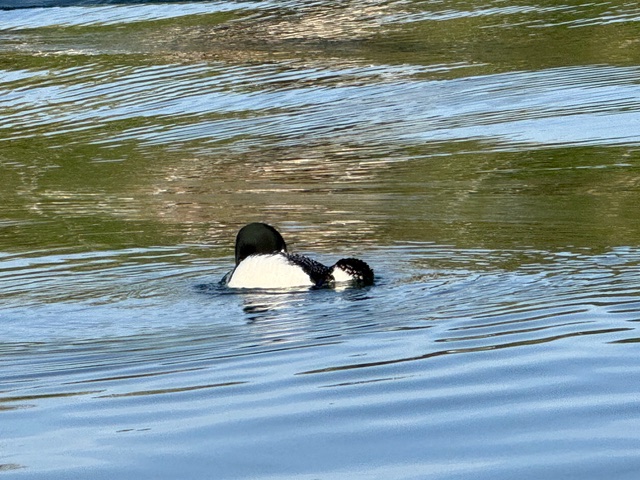
- Give loons their space. Watch loons from at least 200 feet away and use binoculars or a spotting scope for a closer look.
- Stay away from nests and chicks. Never approach a loon nest, and give adults with young chicks plenty of room.
- Boat responsibly around loons. Never chase loons or steer boats or personal watercraft toward them. Slow down and give loon families a wide berth.
- Use lead-free fishing tackle. Lost lead sinkers and jigs can be deadly to loons and other wildlife.
- Protect natural shoreline habitat. Native vegetation provides important nesting and feeding habitat for loons.
- Keep fishing line and trash out of the lake. Discarded line can entangle wildlife, and garbage can attract predators.
- Keep dogs away from loons and nests. Pets can disturb nesting adults, eggs, and chicks.
Sick, Injured, Hooked, or Entangled Loon?
If you see a loon that is sick, injured, hooked or entangled in fishing line, contact Minnesota Loon Rescue. Note the loon’s location and, if possible, take photos or video from a safe distance. Please don’t attempt to capture the loon yourself.
Phone or text: 1-855-552-1500
Email: Sheila@MNLoonRescue.org
Long Lake’s Artificial Nesting Platform
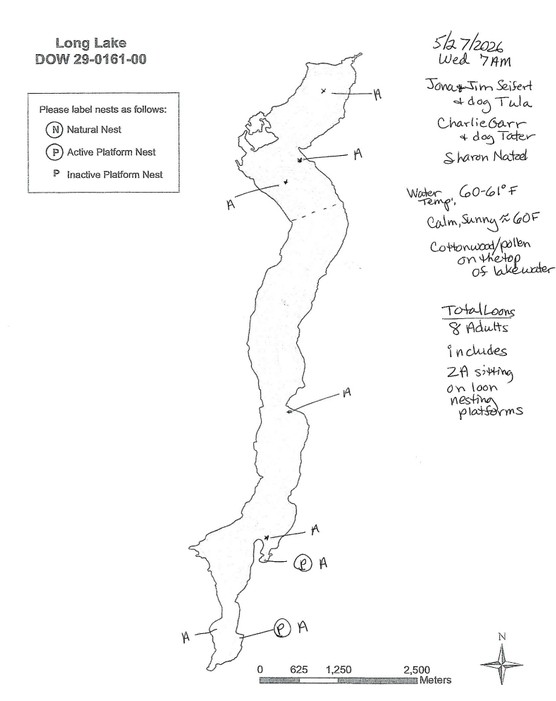
Artificial nesting platforms have been used on Long Lake since the 1980s to provide loons with protected nesting sites where suitable natural habitat is limited. LLAA volunteers have maintained and monitored the platforms over the years.
Long Lake’s current artificial nesting platform has been successfully used by nesting loons each spring for 11 consecutive years, making it a long-running part of the lake’s loon conservation efforts.

Loon Monitoring on Long Lake
Long Lake volunteers participate in the Minnesota DNR LoonWatcher program, monitoring adult loons, chicks, and nesting activity on the lake. Long Lake has participated in loon monitoring through the program since 1999, providing a long-term record of the lake’s loon population.
Volunteers conduct observations during the nesting season and report annual counts to the Minnesota DNR.
Long Lake LoonWatcher August Counts
| Year | Adult Loons | Juvenile Loons |
|---|---|---|
| 2023 | 13 | 3 |
| 2024 | 12 | 4 |
| 2025 | 14 | 6 |
August counts reported through the Minnesota DNR LoonWatcher program.
Want to Help Protect Long Lake’s Loons?
Long Lake’s loon monitoring program depends on volunteers and community awareness. Learn how you can get involved with Environmental Stewardship efforts and help protect wildlife habitat on the lake.
Learn More About Loons
- Minnesota DNR – Common Loon: Learn about loon behavior, reproduction, habitat and conservation.
- Minnesota DNR – Minnesota Loon Restoration Project: Learn about statewide efforts to restore and protect Minnesota’s loon population.
- Minnesota Loon Rescue: Help for sick, injured, hooked or entangled loons.
- National Loon Center: Learn about loon calls, behavior and conservation.
- Threats to Loons: Learn about threats including lead tackle, fishing-line entanglement and changing water levels.
